Oktoberfest 2026: Complete Travel Guide for First-Timers and Regulars
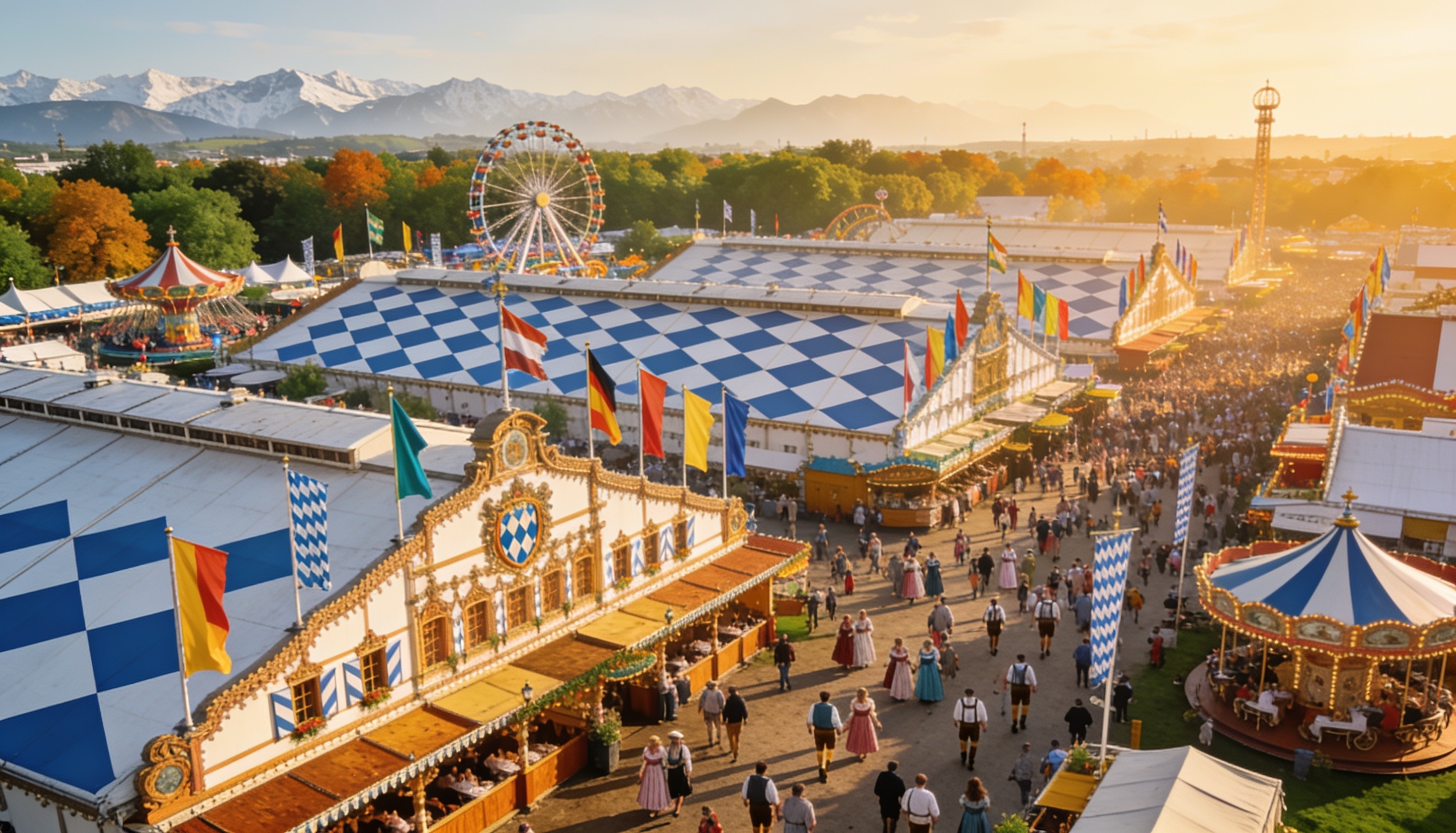
Oktoberfest 2026 runs from 19 September to 4 October at the Theresienwiese in Munich — and over six million visitors will pass through those gates across 16 days. The world's largest folk festival is many things at once: a serious beer culture event, a traveling funfair, a fashion show for Dirndl and Lederhosen, and the loudest, friendliest crowd you'll find anywhere in Europe come September. Whether it's your first Wiesn or your tenth, the gap between a frustrating visit and an unforgettable one usually comes down to one thing: knowing what to do before you arrive.
What Is Oktoberfest 2026?
Oktoberfest 2026 takes place 19 September – 4 October at Theresienwiese (Wiesn) in Munich, Germany. The festival grounds are free to enter. It features 14 major beer tents serving Bavarian beer brewed within Munich's city limits, traditional food, fairground rides, and live Bavarian brass bands. Traditional dress — Dirndl for women, Lederhosen for men — is expected inside the big tents.
What began as a royal wedding celebration in 1810 has grown into the world's most recognizable folk festival. The core experience happens inside the 14 large beer tents, each with its own personality, brewery affiliation, and crowd. Outside, the fairgrounds sprawl across 42 hectares of rides, roast chicken stalls, gingerbread hearts, and smaller traditional tents. Entry to the grounds is completely free — you only spend once you're inside.
Beer served at Oktoberfest is a special Märzen (or Festbier) brewed exclusively by Munich's six major breweries: Augustiner, Hacker-Pschorr, Hofbräu, Löwenbräu, Paulaner, and Spaten. No other beers are served in the main tents. Each brewery runs its own tent, and locals often have strong loyalties — the Augustiner tent, for example, is famous for being the most traditionally Bavarian, while the Hofbräu-Festzelt is known for its international, party-heavy crowd.
Oktoberfest 2026 Dates and Opening Hours
The festival opens on the first Saturday after September 15, following the traditional tapping of the first keg by Munich's Mayor — a ceremony that kicks off the two-week run. For 2026, that means:
- Opening day: Saturday, 19 September 2026 — gates open at 9:00 am; beer service starts at noon
- Final day: Sunday, 4 October 2026
- Weekday hours: 10:00 am – 11:30 pm (beer tents close at 10:30 pm)
- Weekend hours: 9:00 am – 11:30 pm (beer tents close at 10:30 pm)
Best days for first-timers: Wednesday or Thursday in the first two weeks. The atmosphere is lively without the crushing weekend crowds. Monday is traditionally "Family Day" — reduced-price rides and a slightly calmer vibe.
The opening weekend (19–20 September) and the final weekend (3–4 October) are the most crowded. If you want a reserved table in a tent, these dates also require the longest lead time — good spots can be booked out months in advance. Weekday mornings after 10:00 am are the easiest time to walk into a tent without a reservation.
Beer Tent Reservations: How They Actually Work
This is where most first-time visitors get tripped up. Here's what you need to know about reservations at Oktoberfest 2026.
The 25% walk-in rule
By Bavarian law, every beer tent at Oktoberfest must keep at least 25% of its seats available as walk-ins. This means you can always enter a tent without a reservation — but those walk-in seats go fast on weekends and evenings. Arrive early (before noon on weekdays, before 10:00 am on weekends) to claim a walk-in table.
How to get a reservation
Official tent reservations for 2026 opened via the individual tent operators through oktoberfest.de — the official city portal — in spring 2026. If you're planning for this year, check for last-minute cancellations or weekday availability directly through the tent's official booking page. Reservations typically come with a minimum food and drink spend, not just a seat booking.
Which tent for which traveller?
The atmosphere varies significantly between tents. The Augustiner-Festhalle is widely considered the most authentic local experience — Munich residents tend to favour it, the beer is served from traditional wooden barrels, and the music is more traditional brass band than pop covers. The Hofbräu-Festzelt has an international, exuberant crowd and is often where English-speaking visitors end up. The Schützen-Festzelt is known for a younger, party atmosphere with modern music sets. If you're travelling as a group and want the classic singalong experience, the Hacker-Festzelt — nicknamed "Heaven of the Bavarians" for its painted ceiling — is consistently recommended.
What to Wear to Oktoberfest 2026
Traditional Bavarian dress is not compulsory — but if you show up in jeans and a T-shirt, you'll stand out inside the big tents. Well over 90% of visitors inside the major beer halls wear traditional Tracht. Getting into the spirit is part of what makes Oktoberfest feel different from any other festival on the planet.
For women: the Dirndl
A Dirndl is a structured dress with a bodice, full skirt, and blouse, worn with an apron. The placement of the apron bow carries a traditional code: tied on the left means single and available; tied on the right means taken; tied at the back means widowed; tied at the front centre means the wearer isn't sure. For Oktoberfest, a midi or maxi-length Dirndl (reaching below the knee) is the most classically Bavarian choice. Short Dirndls exist but are considered more festive than traditional.
For men: Lederhosen
Lederhosen are leather breeches with suspenders, traditionally made from suede or full-grain leather. Quality matters — the genuine article develops a patina over years of wear and becomes a keepsake. A proper Lederhosen outfit pairs the trousers with a traditional check or linen shirt, knee-high socks (Loferl), and sturdy Haferlschuhe leather shoes. A felt Bavarian hat (Trachtenhut) completes the look but is optional.
Where to get Tracht in Munich
Munich has a thriving market for Tracht rental and purchase, particularly in the weeks before the festival. Department stores including Ludwig Beck and Lodenfrey on Marienplatz carry a wide range. For rental, book ahead — the final week before opening weekend, good-quality rentals sell out fast. If you're treating this as an investment piece, buying in Munich during the festival often yields better authenticity and quality than ordering online.
How to Get to Oktoberfest from Munich and Beyond
The Theresienwiese is in central Munich, making it straightforward to reach from most parts of the city and from the airport. One thing to leave at your hotel: your car keys.
From Munich Airport
Take the S1 or S8 S-Bahn from Munich Airport to Munich Hauptbahnhof (the main train station). The journey takes roughly 40–45 minutes and trains run every 20 minutes. From Hauptbahnhof, the festival is a short walk — or you can take the U4 or U5 U-Bahn one stop directly to Theresienwiese station, which puts you at the festival entrance. The whole airport-to-festival journey takes under an hour.
From central Munich
The U-Bahn is the fastest option. Lines U4 and U5 stop directly at Theresienwiese, right beside the festival grounds. From Marienplatz (central Munich), it's a two-minute U-Bahn ride. Trams also serve the area on lines 18 and 19 toward Theresienwiese during the festival period. Munich's public transit is exceptionally well-run — use it.
By train from other German cities
ICE and IC trains connect Munich Hauptbahnhof with Frankfurt, Berlin, Hamburg, Nuremberg, and Cologne. The journey from Frankfurt takes around three hours; from Berlin, around four. From Hauptbahnhof, Theresienwiese is a short walk or one U-Bahn stop.
Skip the car. Parking near the festival grounds is extremely limited and the surrounding streets are heavily restricted during Oktoberfest. Public transport is faster, cheaper, and the logical choice for a day where you plan to drink beer.
First-Timer Tips for Oktoberfest 2026
Six million visitors means the Wiesn has seen every mistake in the book. These are the ones worth avoiding.
- Arrive early. For walk-in seats on weekends, arrive when the tents open at 9:00 am. By noon on Saturdays, walk-in seats inside the major tents are gone.
- Drink water. Beer steins at Oktoberfest hold a full litre. The standard pace inside the tents is faster than many visitors expect. Most tents will bring you water alongside your beer if you ask.
- Eat before you drink. The roast chicken (Hendl), pork knuckle (Schweinshaxe), and pretzels inside the tents are genuinely excellent — not just festival food. Order early; kitchen queues grow long by mid-afternoon.
- Leave valuables at your hotel. Pickpocketing is a known issue on the busiest days, particularly in the Hofbräu tent and around the U-Bahn exits. A small cross-body bag or a belt bag under your Dirndl or Lederhosen is the practical solution.
- Book accommodation months ahead. Hotels within walking distance of the Theresienwiese are among the most in-demand in Europe during the festival. If you haven't booked yet, search within a 30-minute U-Bahn radius — Munich's transit makes almost anywhere in the city workable.
- Download an offline map. The festival grounds and surrounding streets get extremely busy. Having an offline map means you're not dependent on a data connection when you need it most.
Beyond the Beer: What Else to Do in Munich
Oktoberfest typically runs five to six hours inside the tents — which leaves plenty of time to explore one of Germany's most livable and beautiful cities. Munich rewards the visitors who look beyond the Wiesn.
Marienplatz is the heart of the old city, flanked by the neo-Gothic Neues Rathaus and its famous Glockenspiel, which performs twice daily. The surrounding Altstadt (old town) neighbourhood is excellent for a morning walk before the festival crowds arrive. The English Garden (Englischer Garten) — larger than Central Park — has a river surfing wave, beer gardens open year-round, and the Japanese Tea House. On a warm September day, the Chinese Tower beer garden inside the park is one of Munich's great pleasures.
For history and culture, the Deutsches Museum on Museum Island is the world's largest science and technology museum — an easy half-day that works well on a Monday when crowds are lighter. The BMW Museum and BMW Welt are a short U-Bahn ride north of the centre and are genuinely spectacular even for non-car enthusiasts. And for a day trip, Neuschwanstein Castle — the fairy-tale castle that inspired Disney — is about two hours by train from Munich Hauptbahnhof.
For a complete Munich guide with neighbourhood-by-neighbourhood recommendations, see our Things to Do in Munich 2026 post.
Frequently Asked Questions
Is it free to enter Oktoberfest 2026?
Yes — entry to the Theresienwiese festival grounds is completely free. There is no gate fee or entry ticket. You only pay for what you consume inside: food, drinks, and fairground rides.
Do I need a reservation to get into a beer tent?
Not necessarily. By law, at least 25% of seats in every tent must be available as walk-ins. Your best chance of getting a walk-in seat is arriving early on a weekday — by 10:00–11:00 am. On weekends and evenings, walk-in seats in the most popular tents can be full by noon.
What are the exact Oktoberfest 2026 dates?
Oktoberfest 2026 runs from Saturday, 19 September to Sunday, 4 October 2026. The opening ceremony and first keg tapping takes place on the morning of 19 September.
Is traditional dress required at Oktoberfest?
It's not a formal requirement, but Dirndl and Lederhosen are the strong norm inside the major beer tents. Wearing Tracht is part of the experience, and locals and regular visitors expect it. You won't be refused entry for wearing normal clothes, but you'll be in a clear minority inside the big tents.
What is the best day to visit Oktoberfest?
Wednesday or Thursday during the first two weeks of the festival. You get the full atmosphere — packed tents, live brass bands, traditional Bavarian energy — without the crushing weekend crowds. Monday is quieter still and traditional "Family Day" with reduced-price fairground rides.
How do I stay connected at Oktoberfest without paying roaming fees?
A travel eSIM for Germany is the most straightforward option — activate it before you land and you're connected as soon as you step off the plane. Compare current plans at roamprice.com/country/germany.
Heading to Munich for Oktoberfest?
Compare travel eSIM plans for Germany — see which plan gives you the best data coverage for your trip length.
Compare eSIM plans for Germany →